We are building a permanent, lawful sanctuary for specialized exotic and regulated nonnative birds in South Hillsborough County, Florida. The Institute is currently in its development and approvals phase. Your support builds secure facilities, long-term care capacity, and lawful alternatives to abandonment or release.
Softbills, passerines, and other specialized or regulated nonnative birds, and the owners who can no longer care for them
Development and approvals — Florida nonprofit corporation, FDACS Reg. No. CH84888, federal 501(c)(3) application pending
Ruskin & Riverview corridor, South Hillsborough County, Florida
Fund secure facilities, offer or connect us to land, volunteer skilled time, or request our governing documents
Founder-led. Family-rooted. Built to outlast a single lifetime.
The Institute exists because exotic birds with nowhere safe to land deserve better than a waiting list. It is being built deliberately, to keep that promise long after any single grant, donor, or news cycle has moved on.
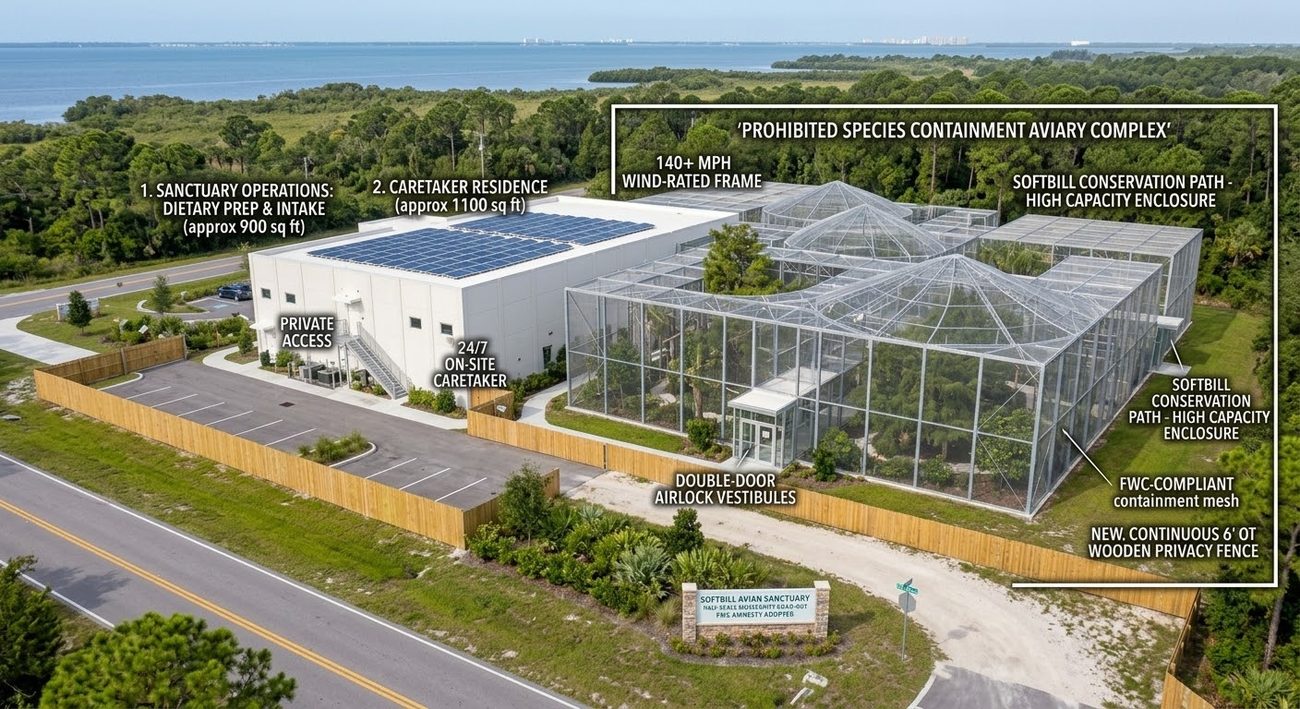
Concept rendering for planning and fundraising purposes. It does not depict an existing facility.
Specialized birds deserve a safe landing place, not a dead end.
The rescue gap
Florida has a large exotic-bird keeping community, but most visible rescue capacity is built around parrots and other hookbills. Softbills, passerines, insectivores, fruit-eating birds, and certain regulated nonnative species need different diets, habitat conditions, flocking arrangements, and containment systems.
The result: a bird can be hard to place not because it lacks value, but because a compatible facility is uncommon. The Institute was formed to build a permanent-care option for exactly this underserved category.
Why it matters for Florida
A bird that escapes or is released faces serious welfare risk and can raise ecological concerns. We are building a lawful, biosecure alternative built on containment, careful intake, lifelong care where appropriate, and owner education before a private-care situation becomes a crisis.
Sanctuary first, not exhibition
Our focus is sanctuary, rehabilitation, and preservation — not commercial exhibition or a tourist zoo. Animal welfare and preventing unlawful release come ahead of any public-facing activity.
Public understanding is part of prevention. Once authorized, we intend to host controlled, scheduled educational programming so visitors can learn about avian history, nonnative species dynamics in Florida, and why regulated nonnative species such as the Red-whiskered Bulbul require lawful authorization, secure containment, and careful management.
Built deliberately, not informally
The Institute is a registered Florida nonprofit corporation and maintains FDACS charitable-solicitation registration. Federal tax-exempt status and any future wildlife authorizations are separate processes. We state clearly, at every stage, what is pending, what is approved, and what is operational.
Josue Sanchez, Founder & Executive Director
Josue Sanchez founded the Institute to turn years of hands-on commitment to exotic avian welfare into a permanent public-serving institution. As Founder and Executive Director, he is responsible for day-to-day operations, regulatory coordination with agencies including FWC and FDACS, fundraising strategy, and the long-term site plan for South Hillsborough County.
His approach is deliberately conservative: build compliance and infrastructure first, grow the number of birds in care only as fast as facilities and funding genuinely allow, and never accept an animal the organization cannot properly and permanently support.
At a glance
Founder & Executive Director
Regulatory compliance, site development, donor stewardship
South Hillsborough County, Florida
Founder-led stewardship with written accountability safeguards.
The Institute currently operates under a Sole Member and Executive Director structure. That is a deliberate choice for a development-stage organization: one accountable leader holds clear responsibility for standards of care, supported by written policies, documented recordkeeping, and a defined succession path. We distinguish plainly between what is in place today and what we intend to add as the organization grows.
Conflict-of-interest safeguards
A written conflict-of-interest policy governs related-party dealings, procurement, and any transaction involving the Founder or family members. Decisions that could present a conflict are disclosed and documented rather than handled informally.
Financial recordkeeping and restricted-gift discipline
Charitable funds are tracked separately from personal funds, with documented receipts, expenditure records, and donor-restriction tracking. Records are maintained to support FDACS reporting and any future IRS filing requirements.
Written succession planning
Succession is addressed in advance in our governance documents, so the animals, land, and obligations in our care transfer through an intentional plan rather than an unplanned event.
Documented care and containment policies
No-release and no-unapproved-breeding standards, containment and escape-response protocols, quarantine practice, and disaster planning are written down and followed regardless of who is on site on a given day.
Planned independent oversight
As operations and funding scale, we intend to add independent professional and advisory oversight — including veterinary, legal, accounting, and advisory-board input — appropriate to the Institute’s size. This is a stated plan, not a current structure.
Multi-generational commitment
We are building an organization a family can steward across decades, because the species in our care and the land we hope to protect need a horizon longer than a single career.
Transparency and accountability
We hold ourselves to the standard we would expect from any organization seeking public trust, land, animals, or charitable support: accurate public disclosures, documented animal-care policies, financial recordkeeping, conflict-of-interest safeguards, and a clear distinction between current status and future goals.
We will share our governing and status materials with serious supporters.
Diligence is welcome. Prospective donors, land partners, grantmakers, and institutional supporters may request the following on request, subject to availability at our current stage of development.
- Florida incorporation information, including our Sunbiz registration record.
- FDACS charitable-solicitation registration (Reg. No. CH84888).
- Current federal tax-exempt application status — our Section 501(c)(3) application remains pending, and no determination letter has been issued.
- Core policy framework, including our no-release, no-unapproved-breeding, and containment commitments.
- Conflict-of-interest and financial recordkeeping policies.
- Development roadmap and site-planning materials, where prepared and available.
Want to know more before you commit?
Prospective donors: your gift funds secure aviaries, quarantine capacity, and long-term care — and we will tell you exactly what stage each project is in. Please note that federal 501(c)(3) status is pending, so contributions should not be treated as federally tax-deductible at this time.
Land partners: if you own, manage, or know of suitable acreage in the Ruskin–Riverview corridor, we would welcome a conversation about sale, donation, or long-term arrangements.
Volunteers and skilled professionals: we are building the roster we will need at authorization — avian husbandry, veterinary, construction, permitting, and administrative support.
Institutional supporters and grantmakers: we are glad to walk you through governance documents, regulatory status, and site plans in detail.